Saturday, 31 March 2012
End of Semester Reflections
As the semester comes to a close, it is time to look back on what I've learned over the past 3 months. Although I've taken many English courses throughout my schooling years, the content matter never sparked my interest much in the subject. Since graduating high school, however, I've come to appreciate arts a lot more and was optimistic coming into English 1080. We looked at many poems, some which were written in interesting forms, which taught me that conforming to a "proper" style is not always the way things need to be done. We also looked at many short stories, which brought up many questions about how our society works and how people are treated. Overall I took a lot out of this English course, and although it is not my major, I am hoping to take more English courses throughout university if possible.

Monday, 12 March 2012
Open Letter
To Charlie (my pet dog),
What are you thinking about, sitting there on the floor? I can only imagine you are dreaming of a world made of dog treats, where you are free to chase cats and roll in mud all day. How wonderful it must be to be a dog.
I hope you don't mind eating the same dog food every day. I know it must get old after a while, but I try to sneak you some food off my plate when no one is looking. I know you love roast beef. I'm sorry I haven't been taking you for a walk very often lately. I will try to find the time from now on.
I can only hope to live my life with such a positive outlook as you do. You are happy for every little thing that happens, and you're always by my side. Dogs truly are man's best friend.
Matthew
What are you thinking about, sitting there on the floor? I can only imagine you are dreaming of a world made of dog treats, where you are free to chase cats and roll in mud all day. How wonderful it must be to be a dog.
I hope you don't mind eating the same dog food every day. I know it must get old after a while, but I try to sneak you some food off my plate when no one is looking. I know you love roast beef. I'm sorry I haven't been taking you for a walk very often lately. I will try to find the time from now on.
I can only hope to live my life with such a positive outlook as you do. You are happy for every little thing that happens, and you're always by my side. Dogs truly are man's best friend.
Matthew
Sunday, 4 March 2012
News Report
BIGFOOT FOUND ALIVE
Sensitive About Foot Size
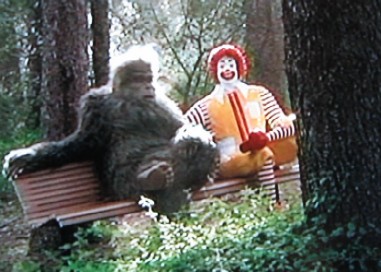
CALIFORNIA -- It was a day many had thought would never come. Experts had argued for nearly a century about the existence of the highly elusive creature, having only amateur photographs and unreliable accounts upon which to base their theories. This weekend however, as if returning from a day of fishing, the mythical "Bigfoot" emerged from the forest in Bluff Creek, California, where he had been spotted a little over a half-century ago. The Daily Bluff caught up the monstrous beast later that day for an interview.
"Sasquatch is the name I prefer", he told our reporters, claiming all the attention around his abnormally large feet has caused him much anxiety over the years. "It's bad enough trying to find shoes that fit. I don't need to be constantly reminded."
Puzzled when asked where he had been all these years, Bigfoot denied hiding from public contact, exclaiming "I even posed for pictures when the opportunity came up."
Standing nearly seven feet tall and weighing over 800 pounds, Bigfoot has garnered much interest from the local NBA team, the L.A. Lakers. Team management believes he would fit very well with their current lineup and give them the size and strength they have been missing since the departure of Shaquille O'Neal in 2004.
"He's definitely the type of player we've been looking for", said Coach Mike Brown in a phone interview, "although we'll have to contact the league officials to bypass the current rules against signing bipedal creatures to league contracts."
"Basketball seems fun", commented Bigfoot,"whatever that is."
For now, though, Bigfoot has stated that he'd rather take it slow while adjusting to life in the city.
"People have been pretty nice to me on the streets", he told reporters when asked about what he thought about finally visiting the city. "I guess we'll see how everything plays out."
"Also, stop calling me Bigfoot."
The Daily Bluff will be sure to stay up to date on Bigfoot`s situation over the coming weeks and months.
Wednesday, 22 February 2012
Review: The Roots - Undun (2011)
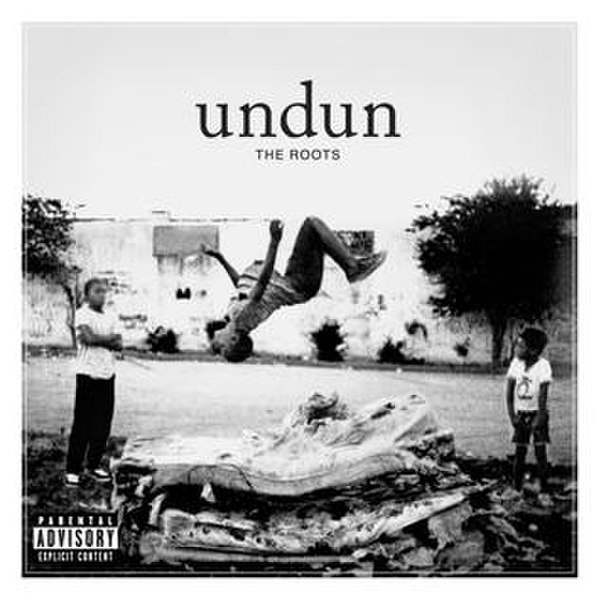
The story is told in reverse-chronological order, beginning with a haunting instrumental played over a fading heartbeat, and ending in five minutes of piano and string ridden pieces. The real treasure in this album comes in between, where The Roots have treated us to tracks reminiscent of their albums from the early 90's. Undun features the regular guests of Phonte, Truck North, Dice Raw and Greg Porn, as well as Sufjan Stevens, Bilal and up-and-comer Big K.R.I.T. . This ensemble of guest acts, combined with the always fresh instrumentation, led by Questlove, and the smooth delivery of Black Thought, provide what could be the most consistent and thought-provoking hip-hop album of the past decade.
The stand-out song on the album, however, has to be "Tip The Scale", which represents the turning point in the life of Redford. It addresses the issue that many black teenagers face while growing up in poverty, which is the decision whether or not to take up a dangerous life of crime in order to escape their own eventual fate of poverty. Dice Raw lives up to his name on this song, providing such a raw hook and verse, which hip-hop enthusiasts will look at for years to come as a classic.
Undun is a must-have for hip-hop and neo-soul fans everywhere. The Roots have proven that some artists do get better with age, and I assure you that this album does not disappoint. In many years, critics will look back and mark this album as not only The Roots best album (to date), but also the best album of the 2000's, and one of the greatest concept albums we will ever hear.
Friday, 10 February 2012
Spoken Word Poetry Analysis
This piece, "Knock Knock" by Daniel Beaty, addresses the issue of an absent father in a young man's life. Beaty tells the story of how during his childhood, his father was incarcerated and consequently, Beaty was raised without a father figure. Beaty uses the name of a game he used to play with his father, "Knock Knock", as a recurring symbol throughout his recitation, which is an aspect that we have looked at in written poetry. Tone, however, is distinguished in this poem not by diction but by the tone and intensity of the speaker's voice as well as facial and body expression. At the beginning of the poem when Beaty is talking about his childhood, his voice is calm and nostalgic as he reminisces over the years he spent with his father. In contrast, at the end of the poem, his voice is raised and he is very dramatic. Tone, and change in tone, is easily distinguishable in spoken word poetry and Beaty uses this aspect to his advantage. There is no rhyme scheme or stanza organization throughout the poem, but that's not to say there is no form; the form is just not conventional. There is surely a distinguishable beginning, middle and conclusion of the poem, with the conclusion referencing back to the start. This "form" is fairly common in spoken word poetry, as it is necessary to be straightforward and clear with the content of the poem to allow the audience to easily understand. This is necessary because, unlike written poetry, the reader cannot go back and read certain lines over again to get a better or deeper understanding. Spoken word poetry in general is very interesting and brings about its own conventions due to the circumstances of performing the poetry orally.
Friday, 3 February 2012


Friday, 27 January 2012
Poetic Inquiry
A Bus Ride
M. Power
open the door
clunk clunk
the clattering of coins
the bus acknowledges this offering with a roar and a jolt
does it not know I've yet to find a seat?
or is it perhaps disgruntled today
a sea of faces gathered together
and split apart
silence
a lady is staring out the window
the adjacent free seat taken up by her bag
"do not disturb"
I sit next to a sleeping man
has he missed his stop?
or is he already at his destination
I wonder where these people are going
a young boy and his father sit quietly
returning home from a day on the city
or maybe on the way
people shuffle to gather their belongings
as their stop is approaching
they pull the string to let the bus know
let us out
they leave as they came
just a passenger in the life of a stranger
I look around for a familiar face
nobody looks back
they are all immersed in books
immersed in music
immersed in thought
immersed in thoughts of the future
of the past
where they're going
or where they came
the bus stops on the road
maybe it needs to catch a breath
I see a girl running towards us
the bus does not
I say nothing
she stomps her foot in frustration
I see my stop ahead
is it time to go already?
I hardly noticed
I hear a familiar clattering at the front
as I get out of my seat
the bus waits this time, though
as I step down the stairs
clunk clunk
close the door
Friday, 20 January 2012
Song Analysis
Hey Rosetta! - There's An Arc
Written by: Tim Baker
Written by: Tim Baker
don’t you swing, like a child,
in a tree, on a tire, in 85?
there’s an arc that your feet will ride
on the way between hate and that sunday fire
in a tree, on a tire, in 85?
there’s an arc that your feet will ride
on the way between hate and that sunday fire
you look so serious
oh, you look so serious
the night is serving us
but you look so serious
and this could be our reward
this could be it
oh, you look so serious
the night is serving us
but you look so serious
and this could be our reward
this could be it
this simple friday night
when you’re loosening your tie
but there’s a tightness in your eyes
when you’re loosening your tie
but there’s a tightness in your eyes
you look so serious
why do you look so serious?
the night is serving us
and we’re deserving it
why do you look so serious?
the night is serving us
and we’re deserving it
and this could be our reward
this could be it
(this could be all we’re owed)
(all we’re owed, all we’re getting)
this could be it
(this could be all we’re owed)
(all we’re owed, all we’re getting)
cause if we swing like a child
then we’re always colliding this time of night
but our arcs – they could align
(we could align! we could align!)
and over gravity comes this kicking child
this kicking child
then we’re always colliding this time of night
but our arcs – they could align
(we could align! we could align!)
and over gravity comes this kicking child
this kicking child
(Lyrics taken from Album Cover)
This song, written by Tim Baker, shows many elements of poetic form, including stanza organization, rhythm, rhyme, and poetic syntax. This song is organized mostly into stanzas of four lines. However, there are two stanzas, "this could be our reward, this could be it", which are only two lines long. The logical reasoning for making these stanzas shorter than the rest is to place more meaning on the content of those lines. As well as stanza organization, rhythm is also seen in the lyrics. Although the rhythm is not uniform throughout the full song, there are examples within individual stanzas. For example, in the first stanza, each line has a pattern similar to two feet with an "unstressed, stressed, unstressed" meter. This type of metrical foot, known as "amphibrach", is often used with playful intent and therefore gives the stanza a playful rhythm, which corresponds well with the lyrics "don't you swing, like a child?". Much like rhythm, the rhyme scheme in this song is not well established. The writer uses similar sounding words at the end of lines, which can be taken as rhymes depending on pronunciation, such as the rhyming of night, tie and eyes. This type of rhyming, nonetheless, is effective in creating interest and flow throughout the song. Finally, poetic syntax is demonstrated in several ways in the lyrics. Commas and dashes are used to show breaks in lines, such as in the line "but our arcs - they could align". The more interesting example, however, is the use of no capital letters throughout the song. It is possible that this is done by the writer to accomplish equality through all the lyrics, as apposed to capitalizing some words which would make them seem more important or make them stand out.
Much like many poems, the writer takes on a persona in this song. It is suggested from the lyrics that the speaker is a woman speaking to a man. This can be said because of the line "when you're loosening your tie", as ties are traditionally worn by men. This speaker takes on a tone of optimism, which can be seen in the lines "why do you look so serious? the night is serving us, and we're deserving it". It appears she is trying to change the man's outlook on life into a happier one. The writer also uses poetic language, such as repetition, assonance, paradox and personification. Repetition is demonstrated through he lines "you look so serious" and "this could be our reward". These are repeated often in the song and are both correlated. They place emphasis on the idea that the reward from life could be the simple things, and if we are always serious then we will never get the chance to enjoy them. Assonance, the repetition of vowel sounds that are not followed by identical consonant sounds, can be seen in the line "on the way between hate and that sunday fire". The words "way" "hate" and "sunday" all contain the same "a" vowel sound. A paradox can be seen in the lines "when you're loosening your tie but there's a tightness in your eyes." Although loose and tight are both opposites, this line makes a lot of sense and suggests that even when work is finished, it is hard to relax and take your mind off things. Finally, personification is used by the writer in the line "the night is serving us". The night cannot really serve people, however it is effective in giving the idea that the night, or nature in general, is a gift in life and something for us to enjoy.
Not only is this song a good example of a poem expressed through song, but it is also very rich in ideas and provokes thought in the audience. To me, this song talks about how society is too caught up on certain aspects, such as work and education, and does not put enough focus on enjoying the time we have on earth. Many people work hard throughout their whole life, expecting that it will all pay off in the end, but realize, when it's too late, that they were always too busy to enjoy the real gifts of life. The title, "There's An Arc", is perhaps suggesting that we all have our own arcs, or rainbows, throughout or lives that we need to enjoy. When we are children, we enjoy everything, as suggested in the first stanza, but as we grow older we become more and more serious and forget to stop and smell the roses every once in a while. The last stanza, I believe, is suggesting that if the speaker and the addressee's "arcs could align", meaning that they could enjoy each other, and perhaps even start a family, suggested by "kicking child". This song is truly well written in all aspects of poetry and song and I enjoy it very much for these reasons.
- M. Power
Monday, 9 January 2012
Influence of Form on a Haiku
It is evident that the form of a Haiku has a large influence on both its content and the messages or images portrayed by the poem. A traditional Haiku contains references to nature and alludes to a season, which limits what the poet can write about. It will also customarily contain only three lines and follow a 5-7-5 syllable count, which limits how much the poet can write. Due to these two limitations, a Haiku will normally contain three separate, but connected, images of nature. They are not rich in figurative meaning, but do present imagery in a captivating way due to the need to be brief but effective in explanation and details.
- M. Power
Limerick
There was a tall fellow named Fred,
Who could no longer fit in his bed.
He took a trip to the store,
But when he walked in the door,
On the door-frame he walloped his head.
- M. Power
Who could no longer fit in his bed.
He took a trip to the store,
But when he walked in the door,
On the door-frame he walloped his head.
- M. Power
Subscribe to:
Comments (Atom)