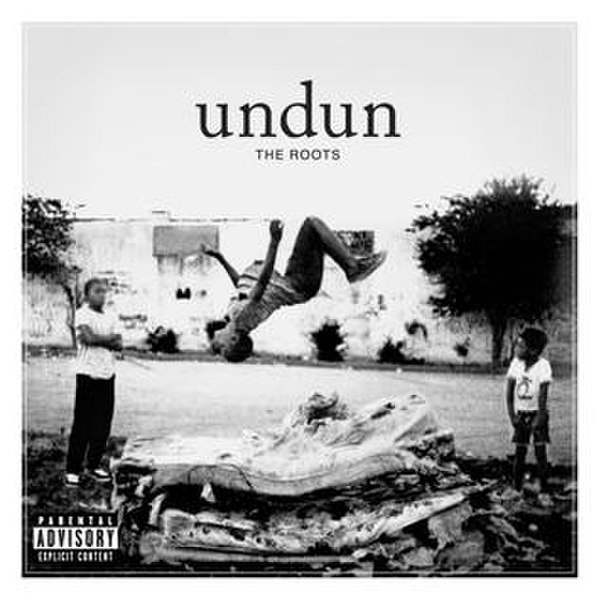
Almost 25 years after the group's formation, The Roots continue to show why they are one of the most long running and critically acclaimed acts in hip-hop history with the release of their eleventh studio album, Undun. The Philadelphia-based group, led by Ahmir "Questlove" Thompson and Tariq "Black Thought" Trotter, has provided us with an artistic masterpiece in this album, recounting the life and death of Redford Stevens, a young urban male who struggles to make something for himself in the world.
The story is told in reverse-chronological order, beginning with a haunting instrumental played over a fading heartbeat, and ending in five minutes of piano and string ridden pieces. The real treasure in this album comes in between, where The Roots have treated us to tracks reminiscent of their albums from the early 90's. Undun features the regular guests of Phonte, Truck North, Dice Raw and Greg Porn, as well as Sufjan Stevens, Bilal and up-and-comer Big K.R.I.T. . This ensemble of guest acts, combined with the always fresh instrumentation, led by Questlove, and the smooth delivery of Black Thought, provide what could be the most consistent and thought-provoking hip-hop album of the past decade.
The stand-out song on the album, however, has to be "Tip The Scale", which represents the turning point in the life of Redford. It addresses the issue that many black teenagers face while growing up in poverty, which is the decision whether or not to take up a dangerous life of crime in order to escape their own eventual fate of poverty. Dice Raw lives up to his name on this song, providing such a raw hook and verse, which hip-hop enthusiasts will look at for years to come as a classic.
Undun is a must-have for hip-hop and neo-soul fans everywhere. The Roots have proven that some artists do get better with age, and I assure you that this album does not disappoint. In many years, critics will look back and mark this album as not only The Roots best album (to date), but also the best album of the 2000's, and one of the greatest concept albums we will ever hear.
Wednesday, 22 February 2012
Friday, 10 February 2012
Spoken Word Poetry Analysis
This piece, "Knock Knock" by Daniel Beaty, addresses the issue of an absent father in a young man's life. Beaty tells the story of how during his childhood, his father was incarcerated and consequently, Beaty was raised without a father figure. Beaty uses the name of a game he used to play with his father, "Knock Knock", as a recurring symbol throughout his recitation, which is an aspect that we have looked at in written poetry. Tone, however, is distinguished in this poem not by diction but by the tone and intensity of the speaker's voice as well as facial and body expression. At the beginning of the poem when Beaty is talking about his childhood, his voice is calm and nostalgic as he reminisces over the years he spent with his father. In contrast, at the end of the poem, his voice is raised and he is very dramatic. Tone, and change in tone, is easily distinguishable in spoken word poetry and Beaty uses this aspect to his advantage. There is no rhyme scheme or stanza organization throughout the poem, but that's not to say there is no form; the form is just not conventional. There is surely a distinguishable beginning, middle and conclusion of the poem, with the conclusion referencing back to the start. This "form" is fairly common in spoken word poetry, as it is necessary to be straightforward and clear with the content of the poem to allow the audience to easily understand. This is necessary because, unlike written poetry, the reader cannot go back and read certain lines over again to get a better or deeper understanding. Spoken word poetry in general is very interesting and brings about its own conventions due to the circumstances of performing the poetry orally.
Friday, 3 February 2012
Subscribe to:
Comments (Atom)
